


Looking for trusted painting and decorating in Glasgow? HomeDecorZone is a Glasgow-based decorating company with deep roots in the trade — painting and decorating is, quite literally, where our business began. Long before we expanded into full kitchen and bathroom renovations, we were on ladders across Glasgow tenements with a brush in hand. Today our painting and decorating service is still one of the core things we do, and we take a huge amount of pride in delivering finishes that genuinely last.
What our prices include
All prices on this page are labour plus building materials — plaster, plasterboard, pipework and plumbing fittings, electrical cable and accessories, timber, adhesives, grout, sealants and fixings — and include VAT. Every quote is itemised line by line.
Not included (you buy these, or we can supply and add them to the quote): kitchen units and appliances, bathroom suites and tiles, flooring, paint and any bespoke joinery — quoted separately or supplied by you. You get our 10% trade discount at Topps Tiles, B&Q TradePoint, Wholesale Domestic and Victoria Plumbing.
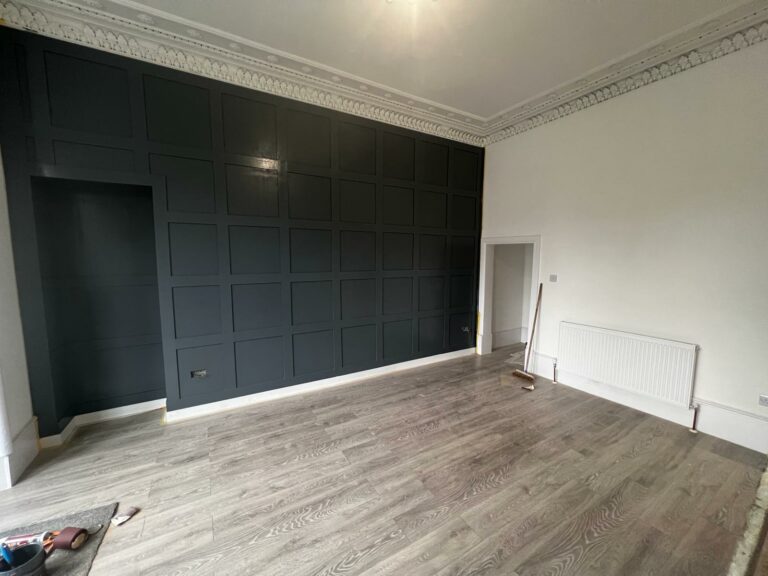
✅ Over a decade of painting & decorating across Glasgow
✅ fully managed painters & decorators
✅ Fixed-price quotes — no hidden costs
✅ Full preparation before a brush ever touches the wall
✅ Wallpapering, lining paper & specialist finishes
✅ Dulux, Johnstone’s and Farrow & Ball supplied at trade
✅ All of Glasgow and surrounding areas
Free Quote — No Obligation
📞 +44 7568 582337
Or request online →
How Our Painting & Decorating Story Started in Glasgow
HomeDecorZone didn’t start out as a renovation company — we started out as painters and decorators. We’ve been painting and decorating across Glasgow for over a decade now, and that’s actually how the whole business began: brushes, ladders and tenement closes, learning the trade the old-fashioned way — prep first, paint second, never the other way round. Those years of work across Glasgow’s tenements, terraces and new-builds are what eventually grew into the company you see today.
Painting and decorating is therefore our first chapter as a company — and arguably the discipline we know better than any other. Every kitchen, bathroom and renovation project we now deliver finishes with a proper paint job done by people who have been doing it for years. When you book us purely for decorating, you’re getting that same long-standing experience focused entirely on walls, ceilings, woodwork and finishes.
What Our Painting and Decorating Service Includes
A proper decorating job is about 70% preparation and 30% paint. Anyone can roll a wall — getting a finish that still looks crisp five years later is about everything that happens before the topcoat. Here’s what’s included as standard on every painting and decorating project we take on in Glasgow:
- Full surface preparation — sanding, dusting, washing down where required
- Filling — every small hole, crack, gap and nail mark filled, sanded flat and spot-primed
- Caulking — gaps along skirtings, architraves, coving and corners sealed for a clean line
- Mist coat / undercoat — fresh plaster always gets a proper mist coat; bare timber and metal get the correct undercoat or primer
- Two finish coats — never one. Two full topcoats is the only way to get even colour and proper coverage
- Cutting in by hand — sharp lines around ceilings, sockets, switches and woodwork
- Woodwork — doors, frames, skirtings, architraves, dado rails, picture rails, window sills
- Wallpapering — feature walls, full rooms, lining paper, textured and patterned papers
- Ceilings — including stained, smoke-damaged or water-marked ceilings stain-blocked before painting
- Protection & clean-up — dust sheets, masking, and the room left tidier than we found it
Our Painting Process — A Quick Guide
People sometimes ask why a “simple” room repaint takes us three or four days when there are videos online of people slapping a wall in an afternoon. The answer is in the steps. Here’s roughly how we approach a standard room in a Glasgow home:
1. Inspect & Prep
Before anything else, we walk the room and identify every imperfection — hairline cracks in the plaster, settlement cracks above doors, picture-hook holes, scuffs, blown plaster, gaps between skirting and floor, gaps where coving meets the wall. All of these get marked up.
2. Fill, Sand & Caulk
Small holes and dents are filled with a quality filler, left to dry, then sanded back flush. Larger cracks are raked out, filled in two passes if needed, and feathered into the surrounding wall. Every gap along skirtings, architraves and coving is run with a flexible decorator’s caulk for a clean shadow-free line. Skipping this stage is the single biggest reason “fresh” paintwork looks tired within months.
3. Undercoat / Mist Coat
Every filled spot gets spot-primed so it doesn’t “flash” through the topcoat. Fresh plaster gets a proper mist coat (watered-down emulsion) so the topcoat actually bonds to the surface. Bare wood gets a wood primer/undercoat; previously gloss-painted woodwork gets sanded and undercoated so the new finish has something to grip to. Undercoat is non-negotiable — it’s what stops the topcoat looking patchy and what makes the finish last.
4. Two Topcoats
Walls and ceilings get two full coats of the chosen emulsion. Woodwork gets two full coats of eggshell, satinwood or gloss depending on what the client has chosen. One coat is never enough — even with “one-coat” paints, a second coat is what gives you proper colour depth and an even sheen across the wall.
5. Final Inspection
Once everything is dry, we walk the room with the client in daylight to check for any pulls, drips, hairs in the paint or missed spots — and put them right before we leave. That’s the bit a lot of decorators skip. We don’t.
Paints & Brands We Recommend
The paint matters. A premium paint applied properly will outlast a cheap paint applied properly — and it will look better the whole time it’s on the wall. We work with three main brands as standard, and we can supply any colour from any of their fan decks at trade pricing as part of the job:
Dulux
Dulux is our go-to for general residential decorating across Glasgow. Their Diamond Matt and Easycare ranges in particular are excellent for living rooms, hallways and high-traffic areas — they’re genuinely scrubbable, which matters in family homes. The colour range is huge and they can mix any Dulux shade to order, so clients aren’t limited to standard tin colours.
Johnstone’s
Johnstone’s is a trade favourite — particularly their Trade Covaplus Vinyl Matt and Aqua Guard ranges. Excellent coverage, strong opacity, and a finish that holds up well in Scottish properties where humidity and damp can be issues. We use a lot of Johnstone’s on ceilings and on rental refurbs where reliability and a clean finish matter more than designer colour names.
Farrow & Ball
Farrow & Ball is the brand we reach for when a client wants a really high-end, period-correct finish — and it’s a beautiful match for Glasgow’s tenement flats and Victorian/Edwardian houses. The pigment density is what people pay for: the colour shifts subtly through the day in a way cheaper paints simply don’t replicate. We supply the entire Farrow & Ball palette — Hague Blue, Railings, Pigeon, Cornforth White, Hardwick White, and the rest — at trade as part of the job.
If you’ve seen a colour you love in any of these ranges, just send us the name or code — we’ll order it in and bring it to the job. There’s no markup on the paint when we’re doing the work.
Wallpapering & Lining Paper
Wallpaper is back, and it’s back properly. We hang a lot of paper across Glasgow — feature walls, full rooms, hallways, stairwells and ceilings. We’re comfortable with everything from basic woodchip and lining paper through to heavy paste-the-wall vinyls, traditional paste-the-paper patterns, and the more delicate hand-printed papers that need particular care.
Lining Paper — Why We Use It So Often
Lining paper is one of the most useful tools in a decorator’s kit, and one a lot of homeowners don’t fully understand. In short, it’s a plain paper hung on the wall before either painting or wallpapering on top of it. We recommend lining paper in three main situations:
- To hide damaged or uneven walls — Glasgow’s older tenements are full of walls that have been patched, replastered, papered and stripped over the past hundred years. Lining paper bridges fine cracks, evens out minor undulations and gives you a uniform surface to paint or paper over.
- To improve the finish under a topcoat — paint sits beautifully on properly hung lining paper. The wall looks flatter, sharper and more “finished” than paint applied directly to a slightly imperfect plaster surface.
- As a base for delicate wallpaper — expensive wallpapers (Farrow & Ball, Cole & Son, Sanderson, Morris & Co.) hang far better over lining paper. The paste behaves more predictably, joins are tighter, and the wallpaper itself doesn’t get sucked into imperfections in the plaster.
Wallpaper — Patterns, Colours & Textures
The variety of wallpaper now available is enormous. We hang:
- Patterned wallpapers — florals, geometrics, damasks, botanicals, classic stripes and contemporary large-scale prints
- Plain & coloured wallpapers — solid colour papers that give a richer, deeper finish than paint alone
- Textured & structural wallpapers — papers with a physical texture pressed or moulded into them: linen weaves, grasscloth, embossed Anaglypta, blown vinyls and heavy “paintable” texture papers that are designed to be hung first and then painted in any colour you like
- Mural and panoramic papers — single-image murals across an entire wall, increasingly popular in Glasgow living rooms and bedrooms
- Specialist papers — metallic, foil-backed, hand-printed and traditional block-printed papers that need a more careful, slower hang
If you’ve found a pattern you like — or you’re not sure what would suit the room — we’re happy to bring sample books to the consultation and talk through what works with the light and proportions of the space.
Glasgow Tenements, Coving & Period Woodwork
A huge part of our painting and decorating work in Glasgow takes place inside the city’s tenement flats and Victorian/Edwardian houses. These are some of the most beautiful properties in Scotland, but they have their own quirks — and they need a decorator who actually understands them.
Restoring Original Coving & Cornicing
Original Glasgow tenement coving and ceiling roses are often clogged with decades of layered emulsion — every recoat fills the detail in slightly more, and over a hundred years that adds up to plaster mouldings that look soft and undefined. We carefully work back through layers where we can, fill any chips or losses in the plaster, and repaint with a fine finish so the original detail reads sharply again. For badly damaged coving we can also patch in matching sections from cast moulds.
Restoring Old Woodwork
Original tenement woodwork — skirtings, architraves, panelled doors, sash windows, picture rails, dado rails — is usually solid timber and absolutely worth saving. The problem is decades of cheap gloss layered on top, often in cream or magnolia, with brush marks, drips and bits of grit baked into the surface. Our process for restoring old woodwork in Glasgow tenements typically involves:
- Heat-stripping or chemical-stripping where layers are too thick to sand
- Sanding back to a sound, clean surface
- Filling chips, splits and historic damage in the timber
- Knotting and priming any bare timber
- Two coats of undercoat
- Two coats of finish — eggshell or satinwood is now far more popular than full gloss for period work
The difference between a panelled door restored properly and the same door simply “painted over” is honestly hard to overstate. One looks like a piece of furniture; the other looks like a door that’s been painted ten times.
Sash Windows, Bay Windows & Shutters
Sash windows and original shutters need particular care — both because they move, and because they’re often listed or in conservation areas across Glasgow. We mask, sand and repaint sashes without painting them shut, and we can repaint internal shutters either in their original colour or in a contemporary palette to suit a modern interior.
Types of Painting & Decorating Jobs We Take On
Single Room Refresh
The most common job — one bedroom, living room or hallway repainted from top to bottom including ceiling, walls and woodwork. Usually 2–3 days depending on the size of the room and the amount of prep involved.
Whole-House Repaint
A complete interior repaint — every room, every ceiling, all woodwork. Common before moving in, after a renovation, or when selling a property. We work in a sensible order so you can keep using the rest of the house while we’re on the job.
Hallways & Stairwells
Tenement stairwells and tall hallways are a specialism — they need proper scaffold or pole-extended access to do safely, and they’re some of the most visible paintwork in any home. We do these regularly across Glasgow.
New Build & Post-Renovation Decorating
Decorating freshly plastered walls is a different job to decorating existing rooms. New plaster needs proper drying time and a correct mist coat — get either wrong and the topcoat will peel within months. We handle a lot of post-renovation decorating across Glasgow new builds and extensions.
Rental & Landlord Decorating
Quick, clean, hard-wearing repaints between tenancies — sensible neutrals, scrubbable finishes, no fuss. We work to landlord and letting-agent timescales across Glasgow.
Specialist Finishes
Limewash effects, polished plaster looks, panelling and bead-board feature walls, two-tone walls with picture rails as the break line, and colour-drenched rooms (where ceilings, walls and woodwork are all the same shade) — all things we’re happy to do.
Painting & Decorating Cost in Glasgow
Pricing varies depending on the size of the room, the condition of the existing surfaces, and the level of finish required. As a broad guide:
- Single bedroom repaint (walls, ceiling, woodwork) — approx. £450 – £750, 2–3 days
- Living room repaint with prep — approx. £600 – £1,100, 3–4 days
- Hallway, stairs & landing — approx. £900 – £1,800, 4–6 days
- Whole 2-bed flat repaint — approx. £2,200 – £3,800, 7–10 days
- Whole 3/4-bed house repaint — approx. £3,500 – £6,500, 10–15 days
- Wallpapering (per roll, hung) — approx. £35 – £70 per roll depending on paper type
- Lining paper (full room) — approx. £250 – £500 depending on size
Paint from Dulux, Johnstone’s and Farrow & Ball is supplied at trade pricing as part of the job — there’s no separate markup on materials.
Painters & Decorators Glasgow — Areas We Cover
We cover all of Glasgow and the surrounding areas. Our main service areas for painting and decorating include:
- Painters & Decorators Southside Glasgow
- Painters & Decorators Newton Mearns
- Painters & Decorators Bearsden
- Painters & Decorators Paisley
- Painters & Decorators East Kilbride
- Painters & Decorators Shawlands
- Painters & Decorators Giffnock
- Painters & Decorators Clarkston
- Painters & Decorators Milngavie
- Painters & Decorators Bishopbriggs
- Painters & Decorators West End Glasgow
- Painters & Decorators Dennistoun
Get a Free Painting & Decorating Quote in Glasgow
Call us on +44 7568 582337 or use the form below to get a free, no-obligation quote for your painting and decorating project. We’ll visit the property, walk through the rooms with you, talk through colour and paint options, and give you a clear fixed price for the work — including all materials at trade.
Request a Free Quote
Exterior Painting in Glasgow
Painting and decorating isn’t just an indoor job. We do a significant amount of exterior painting across Glasgow every year — and given Scottish weather, it’s some of the most demanding work we take on. Properly done, an exterior repaint can completely transform the look of a property, lift the value, and protect the building fabric for another decade. Done badly, it’ll be peeling and patchy by the second winter.
Our exterior painting service in Glasgow covers the full range of outdoor surfaces and elevations, on traditional sandstone tenements, harled and rendered houses, post-war semis, modern new builds and everything in between.
Render & Masonry — Full House Elevations
We repaint full house elevations — pebble-dash, smooth render, harling and traditional masonry — using proper masonry paints designed for the Scottish climate. The process always starts with a thorough wash-down (usually pressure-washing where appropriate), treatment of any algae, moss or organic growth, repair of any cracked or blown render, and stabilising primer on chalky or powdery surfaces. Only then do the topcoats go on. We use breathable masonry paints on older solid-wall properties so the building can still let moisture out, and high-build smooth or textured masonry paints on more modern walls where coverage and durability are the priority.
Soffits, Fascias & Bargeboards (Podbitki)
Soffits, fascias and bargeboards take a real beating in Glasgow weather — wind-driven rain, UV, the lot. On older properties these are usually timber and need proper preparation before painting: scraping back any failing paint, treating any rot, filling, knotting, priming bare timber and finishing with two coats of a flexible exterior gloss or satinwood. On uPVC fascias and soffits, we use a specialist uPVC primer and a finish coat designed to bond with plastic — the same products we’d use to repaint uPVC windows and doors. Either way, the result is fascias and soffits that look freshly fitted rather than tired.
Front Doors, Windows & External Woodwork
Original tenement front doors, sash and case windows, porch joinery, garden gates, garage doors and external trims — all of these we repaint regularly. External woodwork lives or dies on the prep: sanding back, treating any soft or rotten timber, knotting, priming and undercoating before two coats of a quality exterior eggshell or gloss. We use Dulux Weathershield, Johnstone’s Stormshield and Farrow & Ball’s exterior eggshell ranges depending on what the client wants and where the property sits.
Exterior Walls, Garden Walls & Boundary Render
Garden walls, boundary walls and outbuilding render are often the bits people forget — but a freshly painted house with a tired, mossy garden wall in front of it never looks quite right. We bring exterior walls into the same standard as the main elevation: cleaned, repaired, stabilised, painted to match.
Metalwork — Railings, Gates, Downpipes
Cast-iron railings, original Glasgow tenement gates, downpipes, hoppers, gulleys and balcony work — all of these need a different system to wood or render. We wire-brush back any rust, treat with a rust-converter where required, prime with a metal-specific primer, and finish with two coats of a direct-to-metal paint. Black is still the classic choice for tenement railings; we also do plenty of dark greens, deep greys and “Railings”-shade Farrow & Ball finishes on private homes.
Access — Scaffold, Towers & Cherry Pickers
Tenement gables, three- and four-storey town houses, and tall semis all need proper access. We arrange scaffold, mobile towers or cherry pickers as the job requires — included as part of the quote, never something the client has to source separately. Working from a ladder for hours on end on a four-storey gable isn’t safe and isn’t the way to get a clean finish.
When to Repaint the Outside of a Glasgow Property
As a rough guide, painted render in Glasgow’s climate gives you about 8–12 years between full repaints, depending on the original product and exposure. Painted external woodwork (soffits, fascias, doors, window frames) is more like 5–8 years. The signs to watch for are chalking when you wipe a hand across the wall, hairline crazing in the paint film, lifting around door and window frames, and any black/green organic growth that won’t wash off. Catching it early makes the next repaint much cheaper, because the prep is far less involved.
Eco, Low-VOC & Healthier Paint Options
More and more of our Glasgow clients ask about low-VOC and eco-friendlier paint these days, particularly when there are children, asthma sufferers or pregnant family members in the house. The good news is the major brands have all moved a long way in this direction. Dulux, Johnstone’s and Farrow & Ball all offer water-based, low-VOC ranges across emulsions, eggshells and even exterior products. Water-based eggshell on woodwork in particular has become our default for family homes — it doesn’t yellow over time the way old solvent-based gloss does, it dries fast, and it doesn’t fill the house with that lingering paint smell.
For clients who want to push further, we can specify breathable mineral and clay-based paints (Earthborn, Auro and similar) that are particularly well-suited to old solid-wall Glasgow tenements where breathability genuinely matters for the building fabric.
Colour Consultation & Sampling
Choosing colour is honestly the part most clients find hardest. A shade that looks perfect on a tester square in B&Q can read completely differently on a north-facing wall in a Glasgow tenement at 4pm in November. As part of any decorating quote, we’re happy to:
- Bring fan decks and sample books from Dulux, Johnstone’s and Farrow & Ball to the consultation
- Order tester pots in any shade you’re considering and paint proper A3 patches in two locations of the room (one on a light wall, one on a darker wall)
- Talk through how the light in your specific room will affect the colour at different times of day
- Suggest combinations — e.g. wall colour + ceiling colour + woodwork colour — that read well together rather than fighting each other
If you want to bring in an interior designer or stylist instead, we work happily with their schedule too — we’ll just paint exactly what’s specified.
Painting & Decorating FAQs
Do I really need two coats?
Yes — almost always. Even modern “one-coat” paints look noticeably patchier in side light than the same wall finished with two full coats. Two coats is the only way to get even sheen and proper colour depth, especially on darker shades.
Why is undercoat so important?
Undercoat does two things. First, it gives the topcoat something to bond to — particularly important on bare timber, fresh plaster, filled patches and previously glossed surfaces. Second, it blocks the colour and absorbency of what’s underneath, so the topcoat reads true and even. Skipping undercoat is the biggest reason a paint job looks fine on day one and patchy by day thirty.
How long do I need to leave fresh plaster before painting?
For a normal skim coat, we want to see it fully dry — uniform pale colour all the way across, no dark damp patches. Depending on conditions that’s typically 3–4 days in normal conditions, though it depends on the thickness of the plaster layer. The first coat onto fresh plaster is always a watered-down mist coat, never neat emulsion — neat emulsion sits on top instead of bonding and will peel.
Can I stay in the house while you’re decorating?
Yes, almost always. We work room-by-room, dust-sheet everything, use low-VOC paints by default and tidy up at the end of every day. We’ll just plan the order of rooms with you so the kitchen and at least one bathroom and bedroom are usable at all times.
Do you supply the paint or do I?
Either works. We’re happy to supply all the paint at trade pricing as part of the quote — most clients prefer this because it’s simpler and the cost usually works out lower than buying retail. If you’d rather supply your own (for example because you’ve already bought a specific Farrow & Ball colour you love), that’s completely fine too.
Will you move my furniture?
We move furniture into the centre of the room and dust-sheet it as part of the job. For very heavy or fragile items, we’ll ask the client to move those in advance — partly for safety, partly because we don’t want to be responsible for a hundred-year-old piano.
Can you match an existing colour I already have on the wall?
Yes — both Dulux and Johnstone’s run colour-matching services where they scan a small sample (a chip of plaster or a piece of paper painted with the original) and mix to match. It’s not always a perfect match if the original paint has faded, but it’s usually close enough that it’s invisible on a touch-up.
Our Other Services
Painting and decorating is one half of what we do — the other half is full renovation work. Once the walls are sorted, plenty of clients ask us to take on the rest of the property too. Have a look at our other Glasgow services:
- Bathroom Renovation Glasgow — full bathroom refits, wet rooms, en-suites and accessible bathrooms across Glasgow.
- Kitchen Installation Glasgow — complete kitchen renovations, open-plan conversions and bespoke fits.
- Property Refurbishment Glasgow — whole-house and tenement flat renovations from strip-out to final decoration.
- Contact us — get a free, no-obligation quote for any of the above.
All painting and decorating is done by our Polish-led team — careful prep, sharp lines, no shortcuts. Meet our Polish team.