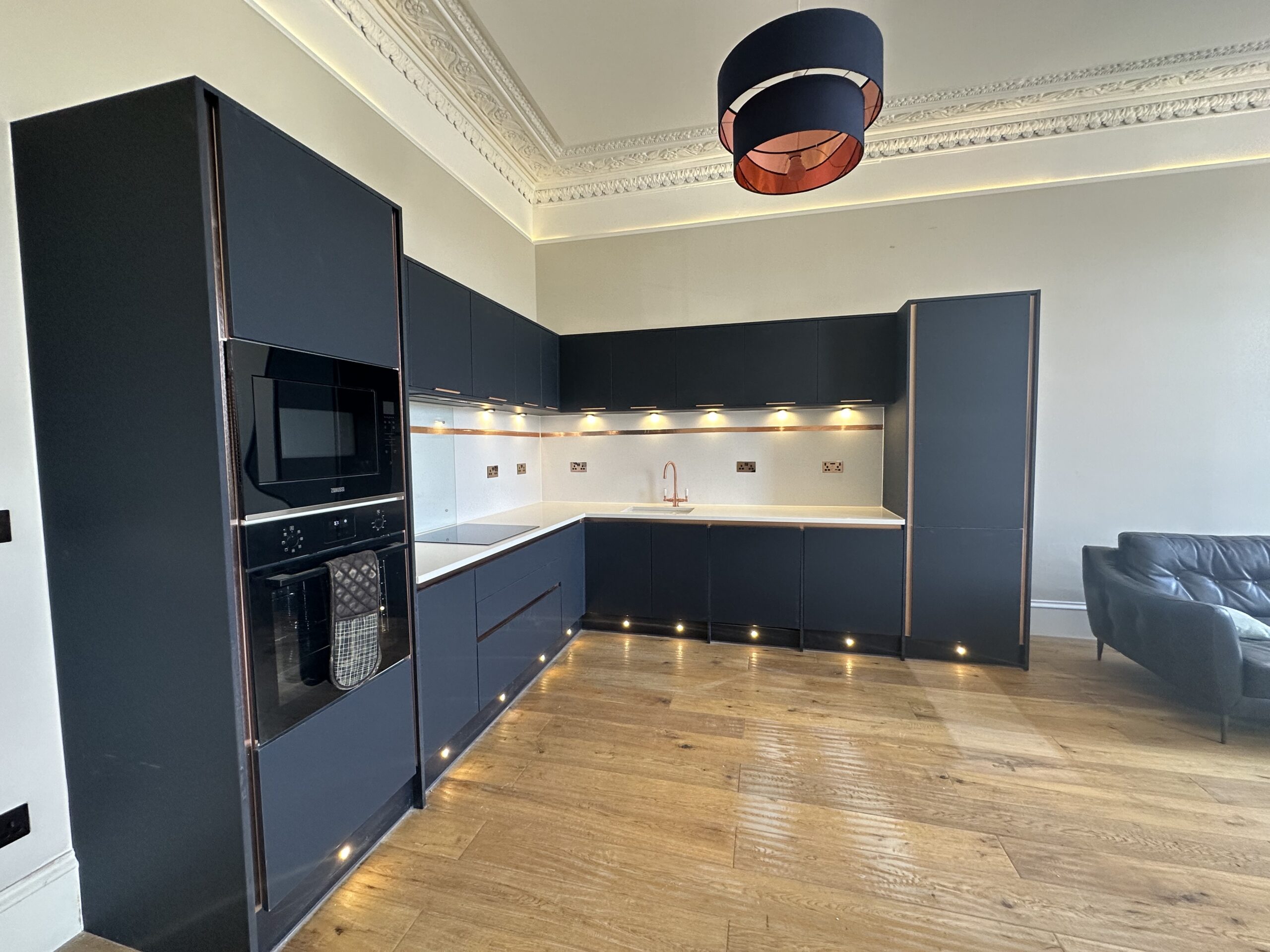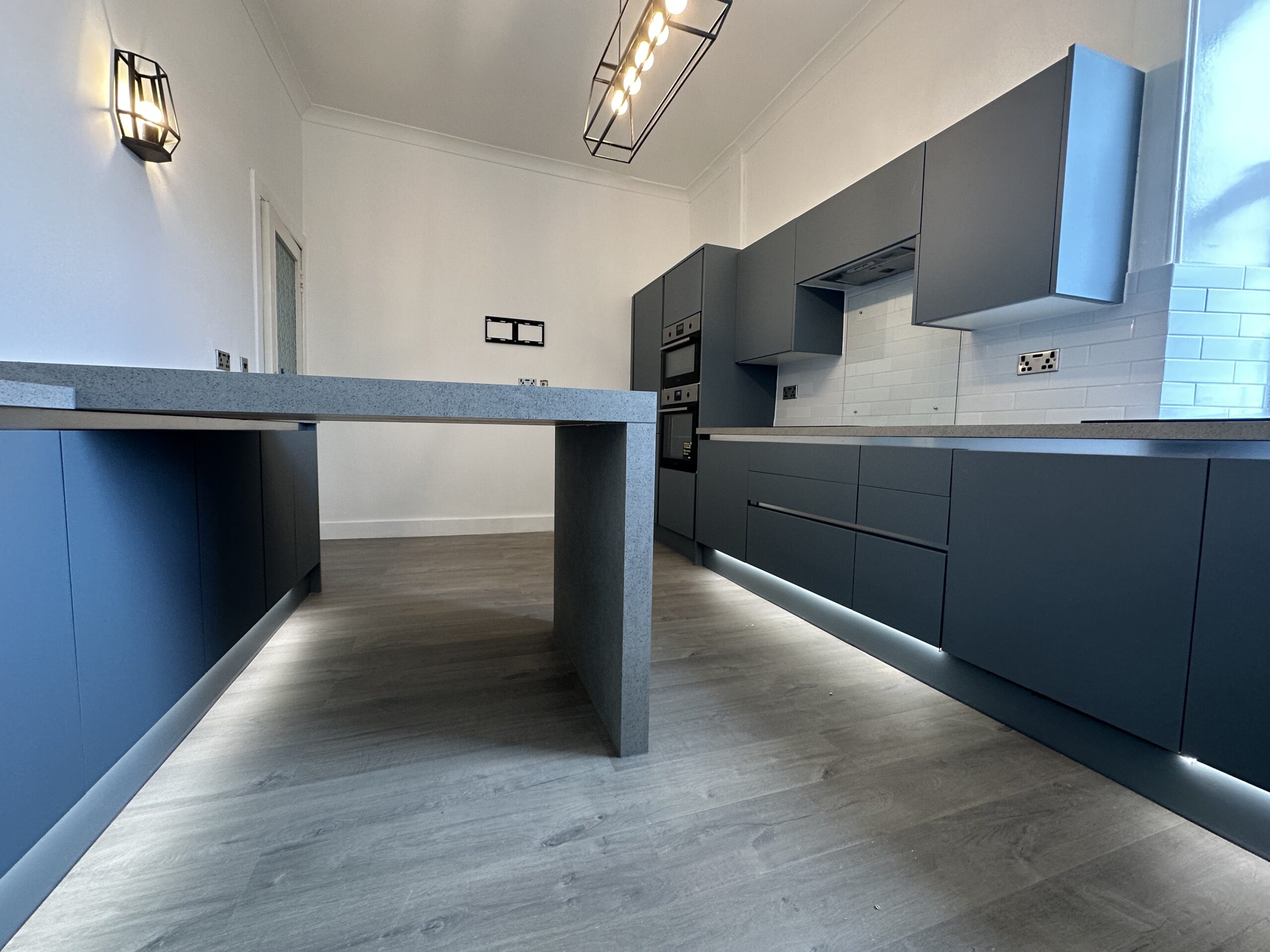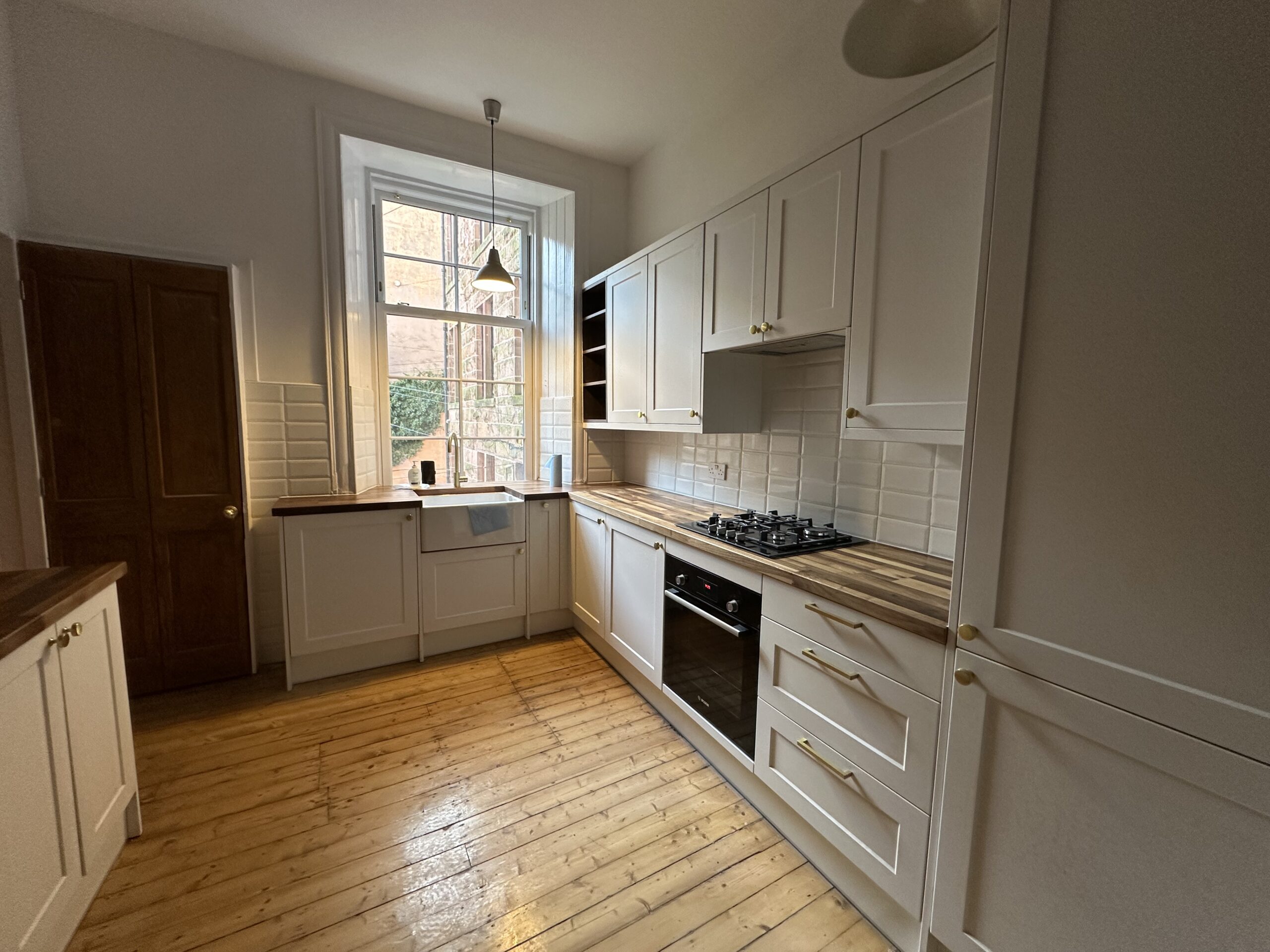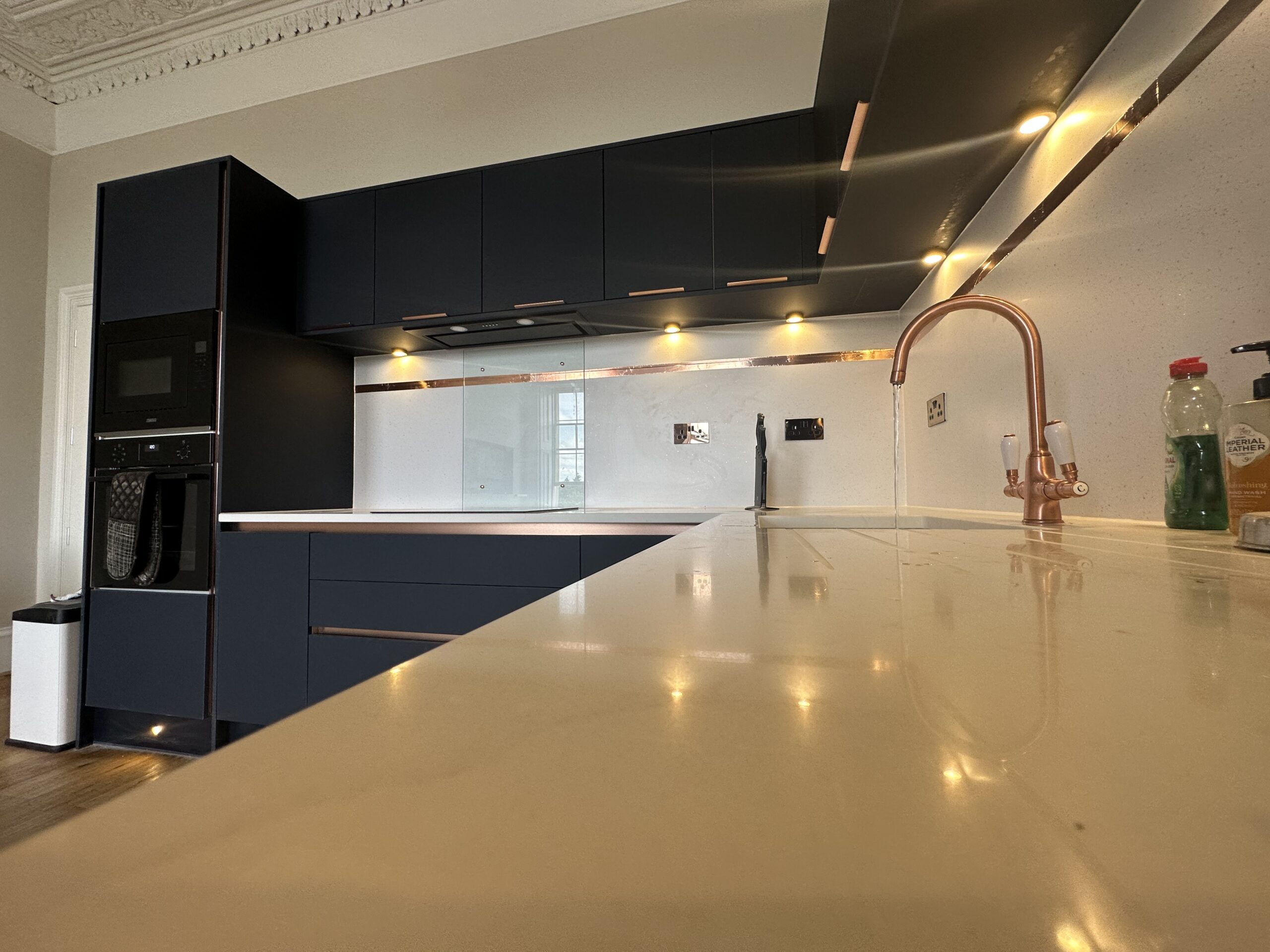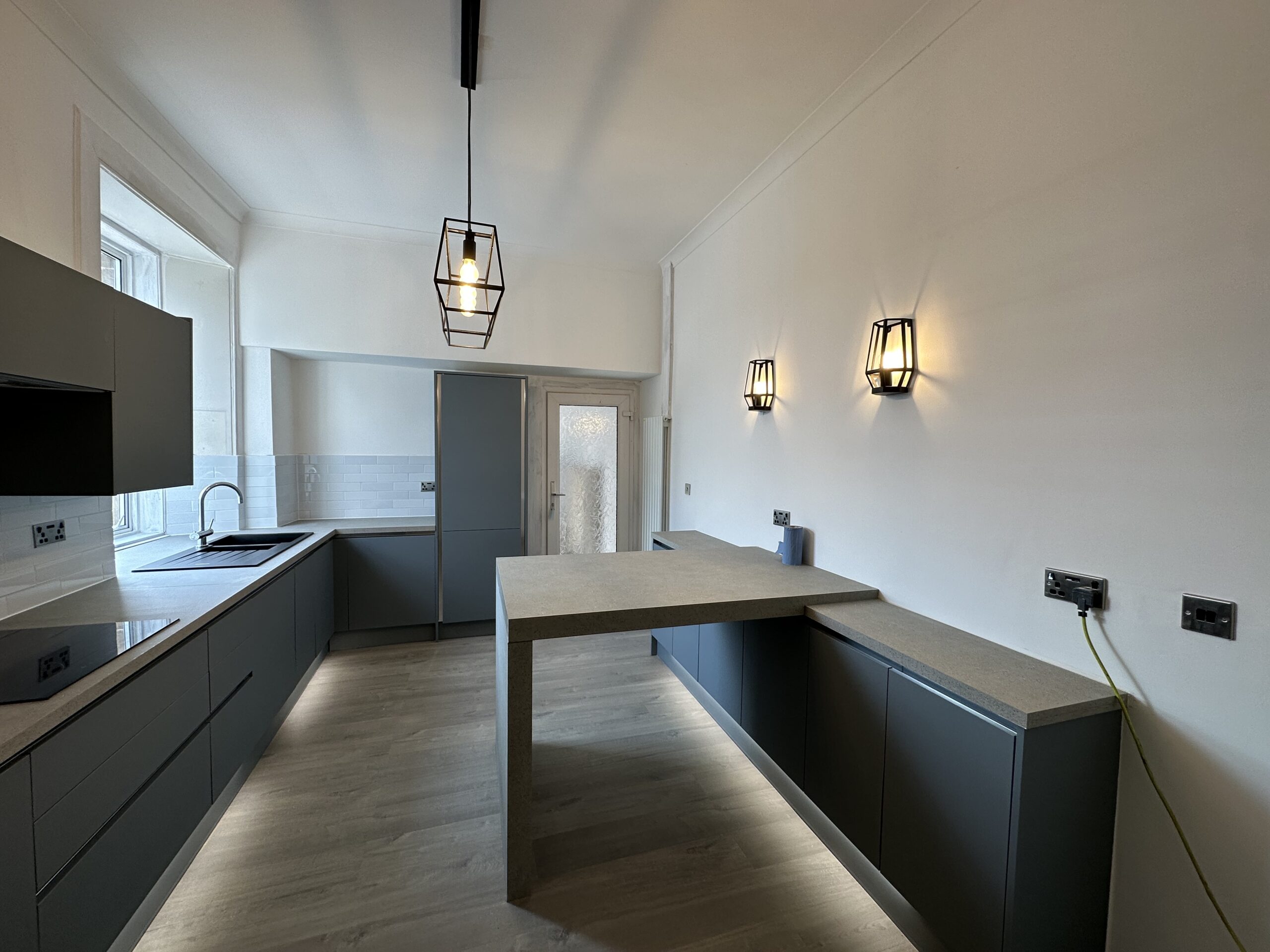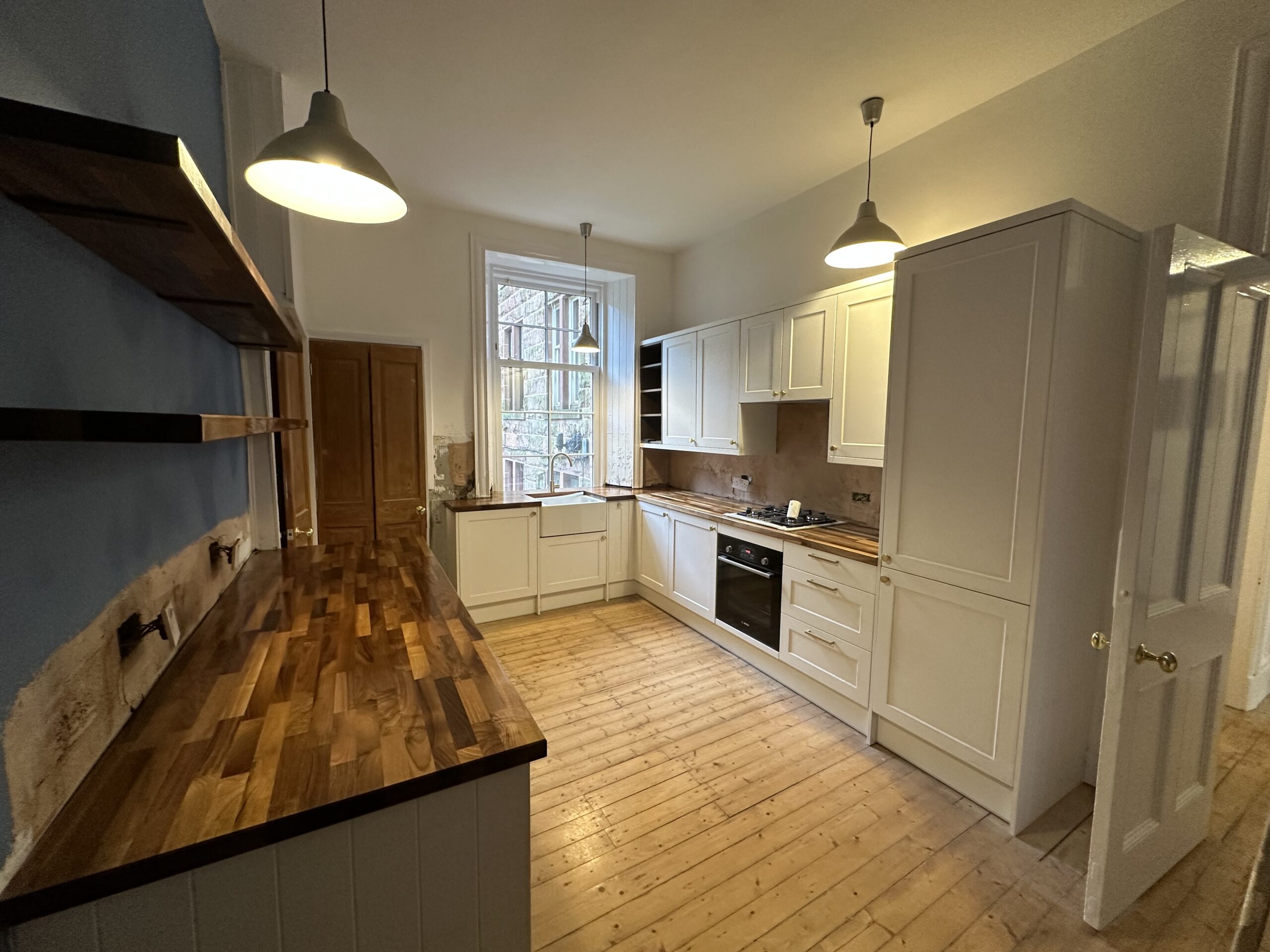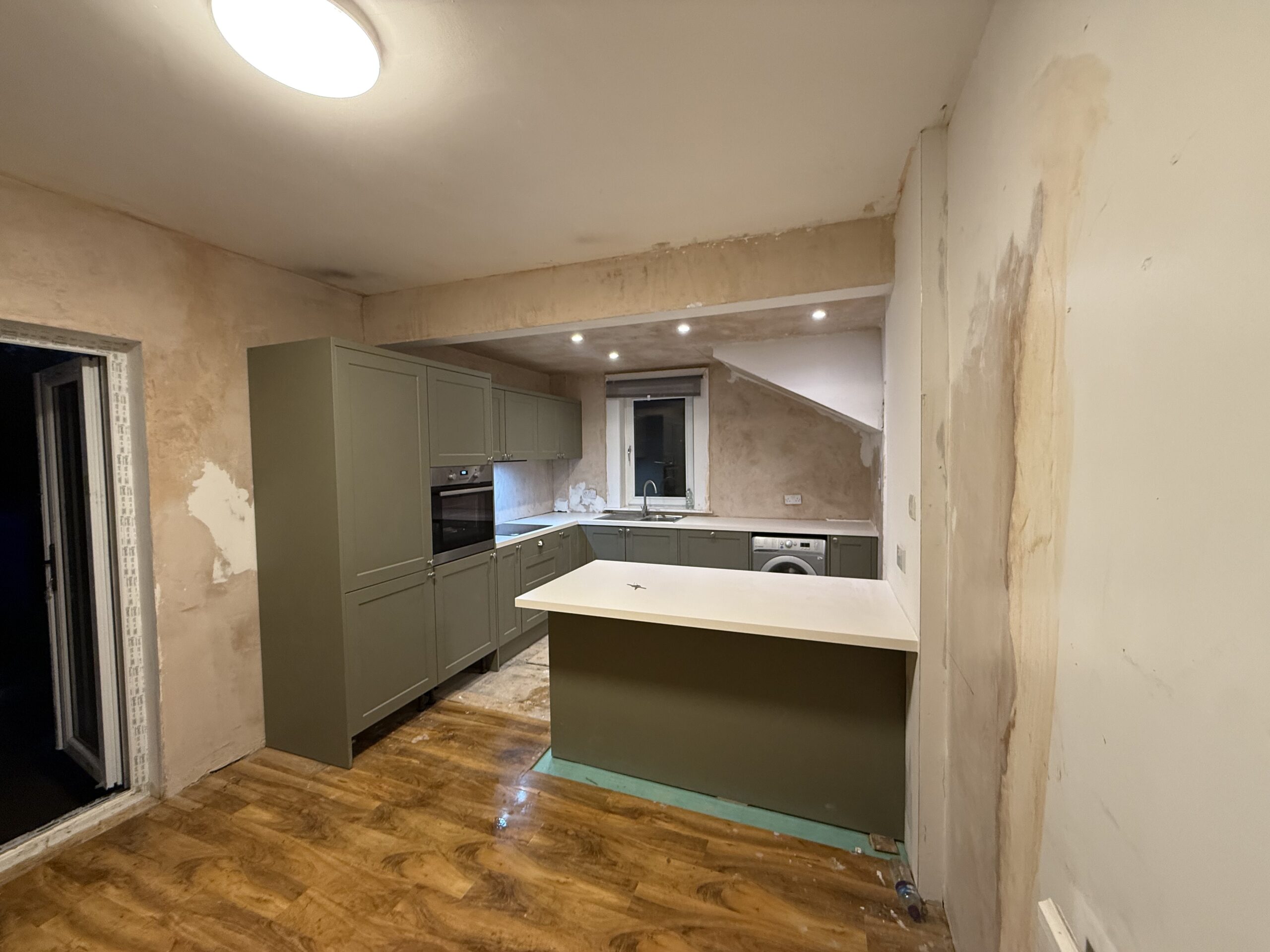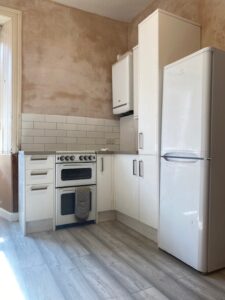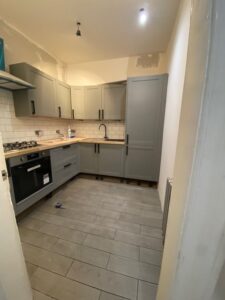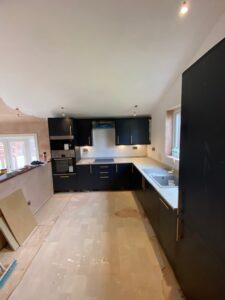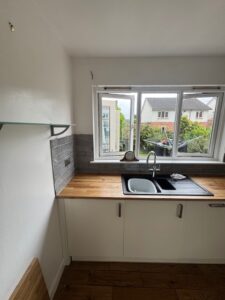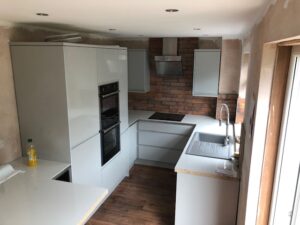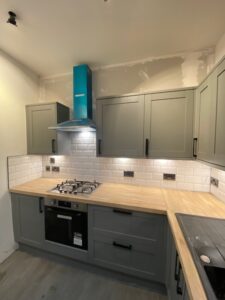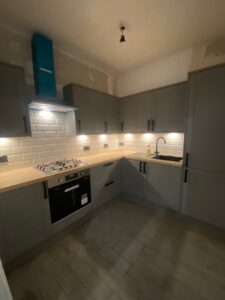


HomeDecorZone has been renovating kitchens across Glasgow since 2011. We’re a family-run company: Thomas leads the work on site, Piotrek looks after design, quotes and ordering — so from the first visit to the final clean-up you deal with the same two people. This guide covers what a kitchen renovation in Glasgow actually involves: realistic costs, timescales, and the decisions worth making before any contract is signed. Rated 9.5/10 on Checkatrade and 4.8/5 from 230 reviews on MyBuilder.
What our prices include
All prices on this page are labour plus building materials — plaster, pipework and plumbing fittings, electrical cable and accessories, timber, adhesives, grout, sealants and fixings — and include VAT. Every quote is itemised line by line.
Not included (you buy these, or we can supply and add them to the quote): kitchen units, worktops, appliances, splashback tiles, flooring, paint. A typical Howdens or Wren kitchen with worktops and appliances runs £3,000–£12,000 on top of our price. You get our 10% trade discount at Topps Tiles and B&Q TradePoint.
Kitchen renovation quote in 48 hours
Fixed, itemised price. Family-run since 2011. Rated 4.8/5 on MyBuilder (228 reviews).
Glasgow Kitchen Renovations Built to Last 15–20 Years
A kitchen is the room you use every single day, and it should be one you genuinely love walking into for the next decade or two — not one you start hating after eighteen months. That is the lens we apply to every single quote we write.
This is why we openly advise against the cheapest off-the-shelf kitchens from B&Q, IKEA budget ranges or no-name suppliers. The savings look attractive on day one. The problem is two or three years later: chipboard carcasses swell where the dishwasher leaks even slightly, soft-close hinges fail one by one, the laminate worktop bubbles around the sink, door fronts start peeling at the edges. You end up paying twice — once for the cheap kitchen, again for the proper one that should have gone in the first time. That is not a deal. That is a tax on the next renovation.
Who we recommend in Glasgow right now
For most clients we recommend Wren or Howdens. Both have proper trade backing in Glasgow, both deliver reliable hinges and runners, both stock spare parts so you can replace a single damaged door five years from now without re-doing the whole run. Howdens has the long-standing reputation and ships fast — usually two to three weeks lead time, which is brilliant when a client wants to be back in a finished kitchen quickly.
That said, over the last two or three years we have noticed Wren slowly creeping ahead on build quality. The carcasses feel heavier, the painted door finish holds up better against everyday knocks, and the in-frame Shaker ranges look properly bespoke rather than mass-produced. We will still spec Howdens if a client wants quick turnaround or has a tighter budget, but if quality is the priority we are increasingly pointing people at Wren. We are not affiliated with either — we just call it as we see it on every installation.
Kitchen Design Advice From Our Fitters
The single biggest planning decision: where the waste runs
Before you fall in love with any layout sketch, find out exactly where the main waste connection for the sink sits. We mean this seriously — it is the single most common cause of unexpected costs and post-installation regrets. The waste pipe drops into the wall or the floor in one specific spot, and every metre you try to move the sink away from that spot adds plumbing labour, falls, access issues and sometimes a pump if gravity will not play.
In an older Glasgow tenement or 1930s semi the waste is often cast iron and runs straight down to a back-court gully. Moving the sink three metres to the opposite wall might mean lifting floorboards, fitting a new waste run with proper fall, and connecting into the soil stack — easily a couple of days of additional labour and parts. In a newer build the soil stack is usually accessible behind plasterboard which is much more forgiving. We always survey this before we agree a layout, never after.
Lighting: LED strips are the cheapest upgrade that transforms a kitchen
Under-cabinet LED strips, plinth lighting and warm-white inside glass display units cost very little extra at the install stage and completely change how the room feels at night. We always quote them as an option even on tighter budgets because the return-on-investment in client satisfaction is the best we see across any line item. Spec warm white (2700–3000K) rather than cool white — it suits home environments far better than the bluish daylight LEDs you see in showrooms.
Island, peninsula or galley — let the room decide
We get asked about islands on almost every quote. They are brilliant when the room can take them — but everything depends on the size and shape of the space. A proper island needs at least 1.0–1.2 metres of clear walkway on all sides for it to feel right and not turn into a daily obstacle. Below that, a peninsula (an L-shape connected at one end) gives you the same prep area and seating without choking circulation. In smaller kitchens a clean galley or single-run with a tall larder cupboard often beats forcing an island in for the sake of it. This is where the room genuinely decides the layout, not Pinterest. We measure properly on the survey visit and walk you through what fits before we draw anything.
The handle-less, no-upper-cabinet look
One trend that has actually got popular in the last couple of years — and which we like, when the room suits it — is kitchens without upper wall cabinets. You replace the wall units with open shelving, a single feature shelf, or just a clean painted wall behind a longer tiled splashback. It makes a smaller kitchen feel twice the size, brings light around the room, and forces you to be a bit more disciplined about what you actually store.
The trade-off: less storage. You either compensate with a tall larder pull-out, a butler’s pantry, or a deeper base-cabinet run with internal drawers. This is a design conversation worth having early — it changes the whole carcass spec.
Splashback options — what we actually fit
Three real choices, ranked by quality and longevity:
- Full tiles (porcelain or ceramic, occasionally natural stone) — the proper, long-lasting option. Wipes down for twenty years, takes heat behind the hob without complaint, and looks honest. Costs more in labour because tiling a full run is a slow job done well. Our recommendation if the kitchen is meant to last.
- Backboards (laminate or acrylic splashback panels) — the cheap-and-fast option. Big panels, screwed or glued behind the worktop, sealed with silicone. They look fine for three to five years, get a bit tired around the hob area, and start showing wear in high-use kitchens. Good for rentals or when budget is genuinely the priority.
- Upstand only with a painted wall — the minimalist option. A short upstand (matching the worktop) seals the worktop-to-wall joint, and the rest of the wall is plastered and painted in a wipeable scrubbable kitchen finish. Cheap, modern, and reads very clean on Instagram-style kitchens. Works best when you have an extractor hood and you are not splashing tomato sauce everywhere.
- Upstand plus a tiled feature behind the hob only — a hybrid we are fitting more and more. The hob area (the bit that actually gets splashed) gets a smart tiled panel, the rest of the run gets the upstand plus paint. Looks great and saves money on tiling labour without losing the wipe-clean section where you need it.
Why Choose HomeDecorZone for Your Glasgow Kitchen?
- Renovation-first fitters — a team that handles structural work, not just cabinet assembly
- One fixed-price contract — strip-out to final finish, no trade-by-trade juggling
- One point of contact from survey to handover
- Fully managed — joinery, plumbing, electrics, gas, tiling and decoration coordinated for you
- 4.8★ from 230 reviews on MyBuilder and 9.5/10 on Checkatrade
Glasgow Properties We Work In
Tenement kitchens are our bread and butter — solid walls, long waste runs to the original stack, and high ceilings that suit full-height storage. We also renovate kitchens in semis and terraces across the Southside and East Renfrewshire, and replace builder-grade kitchens in new-build estates.
Kitchen Brands We Fit in Glasgow
We fit kitchens from all major UK suppliers. Whether you’re going budget-conscious with IKEA or Magnet, mid-range with Howdens or B&Q, or premium with Wren or a bespoke joinery company, the installation standard is the same.
- IKEA — excellent value and design; we know the METOD system inside out.
- Howdens — trade-only cabinetry; we source directly and pass on trade pricing.
- Wren Kitchens — a popular choice for Glasgow homeowners wanting quality at a competitive price.
- Magnet — solid mid-range construction with a wide design choice.
- B&Q / Cooke & Lewis — budget-friendly; we’re happy to fit kitchens you’ve already bought.
- Bespoke & custom joinery — for truly individual kitchens, our joiners produce made-to-measure units and we work with bespoke manufacturers.
Supply-and-fit or fit-only — both are available on one fixed-price contract.
Open-Plan Kitchen Conversions — RSJ & Structural Work
One of our most requested jobs in Glasgow is opening up the wall between a kitchen and dining or living room to create an open-plan kitchen. The work includes:
- Structural assessment to identify load-bearing walls
- Obtaining a building warrant from Glasgow City Council where required
- Installation of steel RSJ beams to support the structure above
- Making good floors, ceilings and walls after the structural work
- Full kitchen fit-out in the newly opened space
We manage the whole process, including liaising with structural engineers and building standards officers, so you have one point of contact from first survey to handover.
Our Kitchen Renovation Process — First Quote to Handover
Our process is simple and we put it in writing every time:
- You contact us — phone, WhatsApp or the quote form on this site. We arrange a free in-home survey usually within a week.
- We survey, measure and talk through what you actually want. We will tell you honestly what fits, what we would not do, and where you could save money without compromising the result.
- You order the kitchen units, appliances and worktop yourself — if you have done your research and you already know which Wren or Howdens spec you want, you go in, talk to the showroom, and place the order. You own that conversation and that pricing.
- Or we help you order — if you would rather not navigate the showrooms alone we send you direct links to the suppliers we use regularly (Wren, Howdens, City Plumbing, Tile Giant, Tap Warehouse), and we sit in on the design appointment with you if useful.
- Or we order everything for you — full project management. We buy the units, appliances, worktop, tiles and consumables on our trade accounts, and you get one invoice covering supply and fit. Often slightly cheaper than retail because of trade margins, and considerably less hassle.
The same three options apply to bathrooms. We have no preference — whichever feels right for you is the one we run with.
Kitchen Renovation Costs in Glasgow
| Type of Kitchen Project | Typical Cost (labour + materials) | Timeframe |
|---|---|---|
| Standard renovation (basic refit, new units, same layout) | £7,000 – £11,000 | 2–3 weeks |
| Layout-change renovation (move fixtures, rerouted services) | £9,500 – £14,000 | 3–4 weeks |
| Open-plan knock-through (RSJ, patio doors, kitchen-diner-living) | £14,000 – £22,000 | 4–6 weeks |
| Premium German cabinetry + Miele/Siemens iQ700 appliances | £16,000 – £28,000+ | 4–6 weeks |
These ranges cover most postcodes in Greater Glasgow. Premium suburbs like Newton Mearns, Bearsden and Milngavie sit at the higher end of each band; Clarkston, Giffnock and East Renfrewshire mid-range areas at the lower end. We quote fixed-price after the survey — no day rates, no creep, no surprises.
Kitchen Fitters Across Glasgow — Areas We Cover
- Kitchen Renovation Newton Mearns (G77)
- Kitchen Renovation Bearsden (G61)
- Kitchen Renovation Milngavie (G62)
- Kitchen Renovation Giffnock (G46)
- Kitchen Renovation Clarkston (G76)
We also cover Shawlands, Rutherglen, Anniesland, Pollokshaws, Bridgeton and all surrounding Glasgow districts — if you are within 45 minutes of the city we will quote.
Frequently Asked Questions — Kitchen Renovation Glasgow
How much does a kitchen renovation cost in Glasgow?
Full kitchen renovations start from £7,000. The final figure depends on structural work, unit quality and worktops — the pricing table above shows indicative ranges for typical Glasgow projects.
How long does a kitchen renovation take?
Most full renovations take one to two weeks on site, longer where walls are moved or floors levelled. Lead time from survey to start is typically four to eight weeks.
Can we stay in the house during the work?
Yes — most clients do. We keep water and power running outside working hours and can set up a temporary washing-up point in another room.
Do I need a building warrant for a kitchen renovation in Scotland?
A like-for-like refit usually does not need one; moving load-bearing walls or altering drainage can. Our building warrant guide covers the rules in detail.
Do you supply the kitchen units and appliances?
Either works: we can supply and fit, or fit a kitchen you have bought from Howdens, Wren, IKEA or elsewhere. We will tell you honestly which route gets you more for your budget. If you only need fitting, see our kitchen fitting Glasgow service (from £2,500).
Which worktops do you fit?
Quartz, granite and laminate — our worktop comparison guide explains the trade-offs.
Book a free Glasgow kitchen survey
Lead time is typically four to eight weeks from quote acceptance, longer if you spec German cabinetry. Phone us on 07568 582337 or request a quote online and we will be in touch within 24 hours.
Related renovation guides
- Kitchen Worktops: Quartz vs Granite vs Laminate
- Does a New Kitchen or Bathroom Add Value to Your Home?
- Do You Need a Building Warrant in Scotland?
Browse all our renovation guides for honest, Glasgow-specific advice.
Related services & areas
Kitchen Renovation by area: Giffnock · Milngavie · Bearsden · Newton Mearns · Clarkston
Explore across Glasgow: House Extensions · Loft Conversion · Garage Conversions · Kitchen Renovation · Bathroom Renovation · Property Renovation
Helpful guides & more
House Renovation Glasgow · How to Find a Reliable Renovation Company in Glasgow · How to Stop Condensation in Your Glasgow Bathroom · Open Plan Kitchen in a Glasgow Tenement: Is It Possible? · How Long Does a Bathroom Renovation Take? (Glasgow Guide 2026) · Wet Wall vs Tiles in a Bathroom: Which Is Better for Glasgow Homes? · Best Bathroom Fitters Glasgow – How to Choose & Why HomeDecorZone · Luxury Bathroom Renovation Glasgow – Marble Tiles, Freestanding Bath and Black Fittings · Bathroom Renovation South Side Glasgow – Real Projects by HomeDecorZone
Related services: Joiners in Glasgow · Flooring fitters in Glasgow
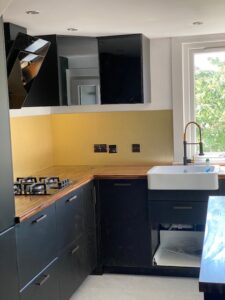
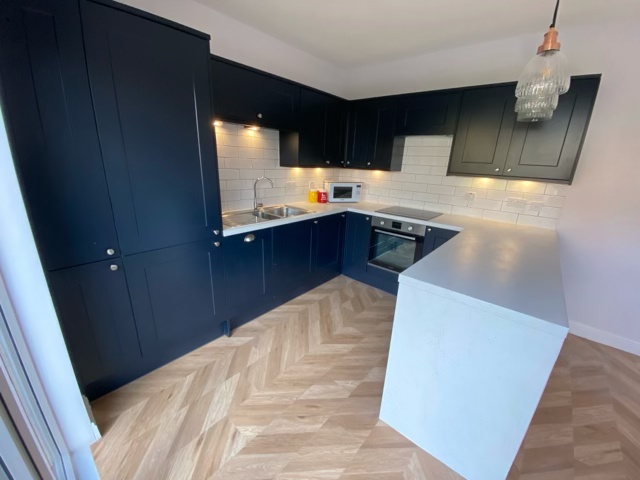
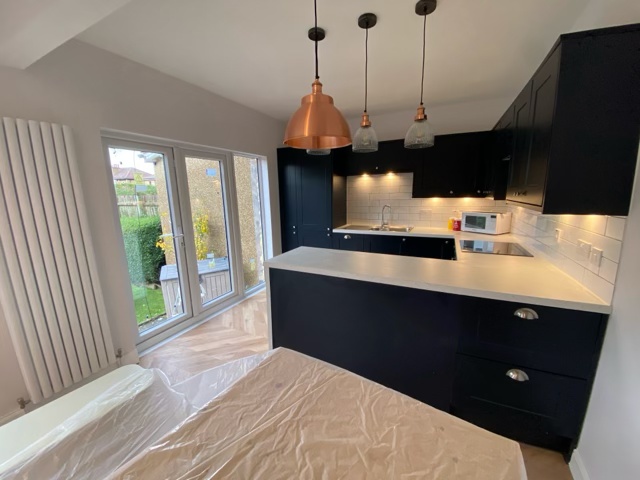
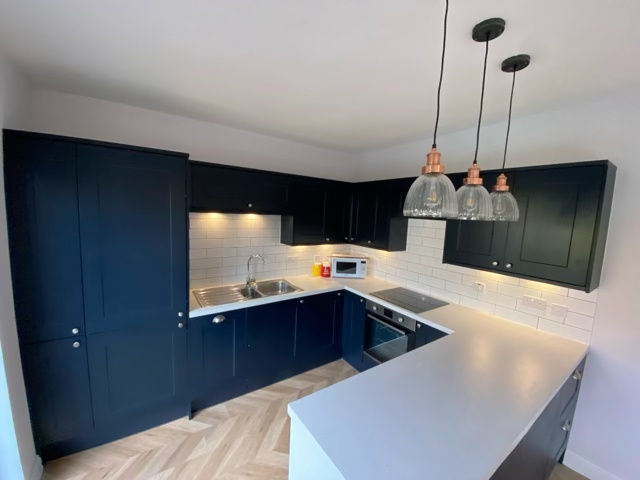
Recent Project: Navy Shaker Kitchen, Clarkston
A recent full kitchen renovation in Clarkston — navy shaker units fitted, tiled and decorated by our team under one fixed-price contract. Read more about opening up kitchen space in our open plan kitchen guide.
Our Kitchen Gallery — Glasgow Projects