


Transform your home with an open plan kitchen in Glasgow. HomeDecorZone specialises in open-plan kitchen transformations — including wall removal, RSJ steel beam fitting, and full kitchen installation — all managed by our team with a fixed price.
What our prices include
All prices on this page are labour plus building materials — plaster, plasterboard, pipework and plumbing fittings, electrical cable and accessories, timber, adhesives, grout, sealants and fixings. Every quote is itemised line by line.
Not included (you buy these, or we can supply and add them to the quote): kitchen units, worktops, appliances, splashback tiles, flooring and paint — typically £3,000–£12,000 for a Howdens or Wren kitchen with appliances on top of our price. You get our 10% trade discount at Topps Tiles, B&Q TradePoint, Wholesale Domestic and Victoria Plumbing.
What does the knock-through cost? See our wall removal & open-plan kitchen cost guide — steel beam, engineer, warrant and a real itemised quote.
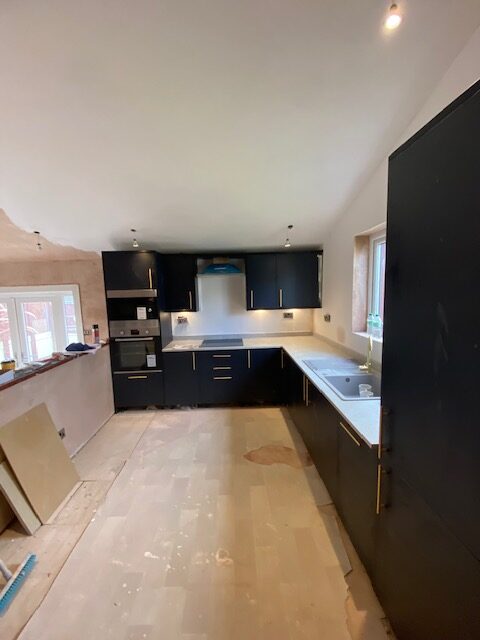
What’s Involved in an Open Plan Kitchen
- Structural survey and planning
- Wall removal (load-bearing or non-load-bearing)
- RSJ steel beam supply and installation
- Building warrant application where required
- Full kitchen design and installation
- Plastering, flooring and decorating
Open Plan Kitchen Costs Glasgow
| Project Type | Approximate Cost |
|---|---|
| Non-load-bearing wall removal + kitchen | £8,000 – £14,000 |
| RSJ installation + open plan kitchen | £12,000 – £20,000 |
| Full open plan renovation | £18,000 – £35,000+ |
Do you need a building warrant? In Scotland, structural work typically requires a building warrant. We manage the application process on your behalf.
- ✅ 9.5/10 on Checkatrade
- ✅ 4.8/5 on MyBuilder — 228 reviews
- ✅ Structural work fully managed
- ✅ Fixed-price quotes
Contact us for a free open plan kitchen consultation in Glasgow.
Related Services & Areas
- Kitchen Installation Glasgow
- Kitchen Fitters Southside Glasgow
- Kitchen Fitters West End Glasgow
- Kitchen Renovation Cost Glasgow
View our full renovation cost guide or get a free quote today.
📞 +44 7568 582337 | Request a Free Quote Online
Open-Plan Kitchen Conversion: How It Works
Removing the wall between your kitchen and dining or living room is one of the most transformative renovations possible — the room feels twice as large, light flows through the space, family life happens in one place rather than separated into rooms. We deliver open-plan conversions across Glasgow as single fixed-price projects covering structural work, kitchen installation, and finishing.
Structural Feasibility: Is the Wall Load-Bearing?
The first question on any open-plan project is whether the wall is load-bearing. In Glasgow housing, the patterns are:
- Tenement flats — most internal walls are non-loadbearing studs; structural calc still required for confidence
- 1930s detached and semi-detached — spine wall (running front-to-back through the house) is usually load-bearing; cross walls often aren’t
- Victorian villa — multiple load-bearing walls common; masonry construction throughout
- Modern detached — lighter timber-frame construction in many cases; structural assessment essential
We engage a structural engineer for every knock-through to produce calculations and specify the steel beam (RSJ) size. Their fee is included in our fixed-price quote.
RSJ Installation Process
- Structural calculations — engineer specifies beam size based on span, load, support points
- Building Warrant application — submitted to local council; we handle
- Acro props installed — temporary support to take load before wall removal
- Wall removed in sections — never all at once; controlled demolition to bedplate
- Padstones bedded into supporting walls — concrete pads to spread RSJ load
- RSJ lifted into position — usually 2–3 men plus lifting gear for heavy beams
- Acro props removed — load transfers to RSJ
- Steel beam fire-protected — intumescent paint or board encasing per regulations
- Plastering and finishing — beam concealed in ceiling line or featured
- Building Control inspection — final sign-off
Building Warrant and Building Control
Open-plan conversions involving load-bearing wall removal require a Building Warrant in Scotland. The process:
- Application submitted to local council with structural engineer drawings — typically 3–6 weeks for approval
- Inspections at key stages: pre-start, during structural work, completion
- Completion certificate issued at handover
- We manage the entire process; you don’t deal with the council
Cost Breakdown
| Component | Cost Range |
|---|---|
| Structural engineer fees | £500 – £1,200 |
| Building Warrant fees | £200 – £600 |
| RSJ supply (depending on span) | £800 – £3,500 |
| Wall removal labour | £1,500 – £3,500 |
| Plastering and finishing | £1,500 – £3,000 |
| Flooring continuation | £1,500 – £5,000 |
| Kitchen installation | £15,000 – £50,000+ |
| Total typical knock-through + kitchen | £28,000 – £55,000 |
Steel Beam Types We Specify
- Universal Beam (UB) — most common, I-shape, range of sizes for spans up to 8m
- Universal Column (UC) — squarer profile, used where the beam will be encased in a low ceiling void
- Twin-RSJ — two beams side by side for very long spans or heavy loads
- Goal post arrangement — vertical posts plus horizontal beam; used where there’s no support wall at one end
Plastering and Finishing Post-Knock-Through
- Beam encasement — usually concealed within a stud frame, plasterboard finished, plaster skim, painted to match ceiling
- Featured beam — steel left visible as design element; suits industrial or contemporary spaces
- Soffit detail — sometimes a clean drop ceiling or shadow gap to define the kitchen area
- Wall make-good — scars from wall removal repaired in plaster, repainted across both rooms
Heating Reconfiguration
- Existing radiators often need repositioning — a wall that’s now gone can’t have a radiator
- Increased heat loss — combining two rooms means total heat demand increases; radiator capacity may need uprating
- Underfloor heating — ideal for open-plan as it heats the entire floor surface, no radiator visual clutter
- Smart zoning — modern systems allow living-side and kitchen-side independent control
Lighting Design for Open-Plan
- Layered scheme — downlights for general light, pendants over island/dining, plinth and under-cabinet for ambient
- Dimmable circuits — mandatory for evening cooking-to-living transitions
- Scene control — “cooking” mode, “dining” mode, “evening” mode all programmable
- Pendant heights — 800–900mm above worktop for islands; 1500mm above floor for dining table
Common Glasgow Housing Knock-Throughs
- 1930s detached — kitchen-to-dining is the most common; spine wall removal occasionally
- 1930s semi-detached — same as detached but with party wall awareness
- Victorian villa — original parlour-to-dining knock-through; preserves period features
- Modern detached — usually open-plan from build; renovations focus on extending into garden
- Tenement flat — back-to-front knock-through in main living area; structural usually straightforward
Frequently Asked Questions
How long does an open-plan conversion take?
Total project 5–8 weeks on site for combined knock-through plus full kitchen installation. Structural work alone takes 1–2 weeks; the rest is kitchen, finishing, and snagging.
Do I need to move out during the work?
Most clients stay in the home throughout. We protect adjoining rooms with dust sheets and work with you to minimise disruption. The kitchen is naturally out of action for the final 2–3 weeks.
What if the wall isn’t load-bearing?
Then no RSJ is needed. Structural engineer still confirms in writing. The work is faster and cheaper — usually £3,000–£5,000 less than a load-bearing knock-through.
Can you handle Building Warrant on my behalf?
Yes — entire process. Application, drawings, fees, inspections, completion certificate. You don’t deal with the council.
Will the new open-plan space have heating issues?
Only if the existing radiators were undersized for the combined volume. We assess this during survey and recommend uprating or underfloor heating where needed.
Related Services
- Kitchen Renovation Glasgow
- Kitchen Renovation Cost Guide
- Kitchen Renovation Newton Mearns
- Kitchen Renovation Bearsden
- Kitchen Renovation Milngavie
- Kitchen Renovation Giffnock
- Full House Refurbishment Glasgow
Your open-plan conversion is handled start to finish by one Polish family-run team — structural work, kitchen fitting and finishing under one roof. About our team.